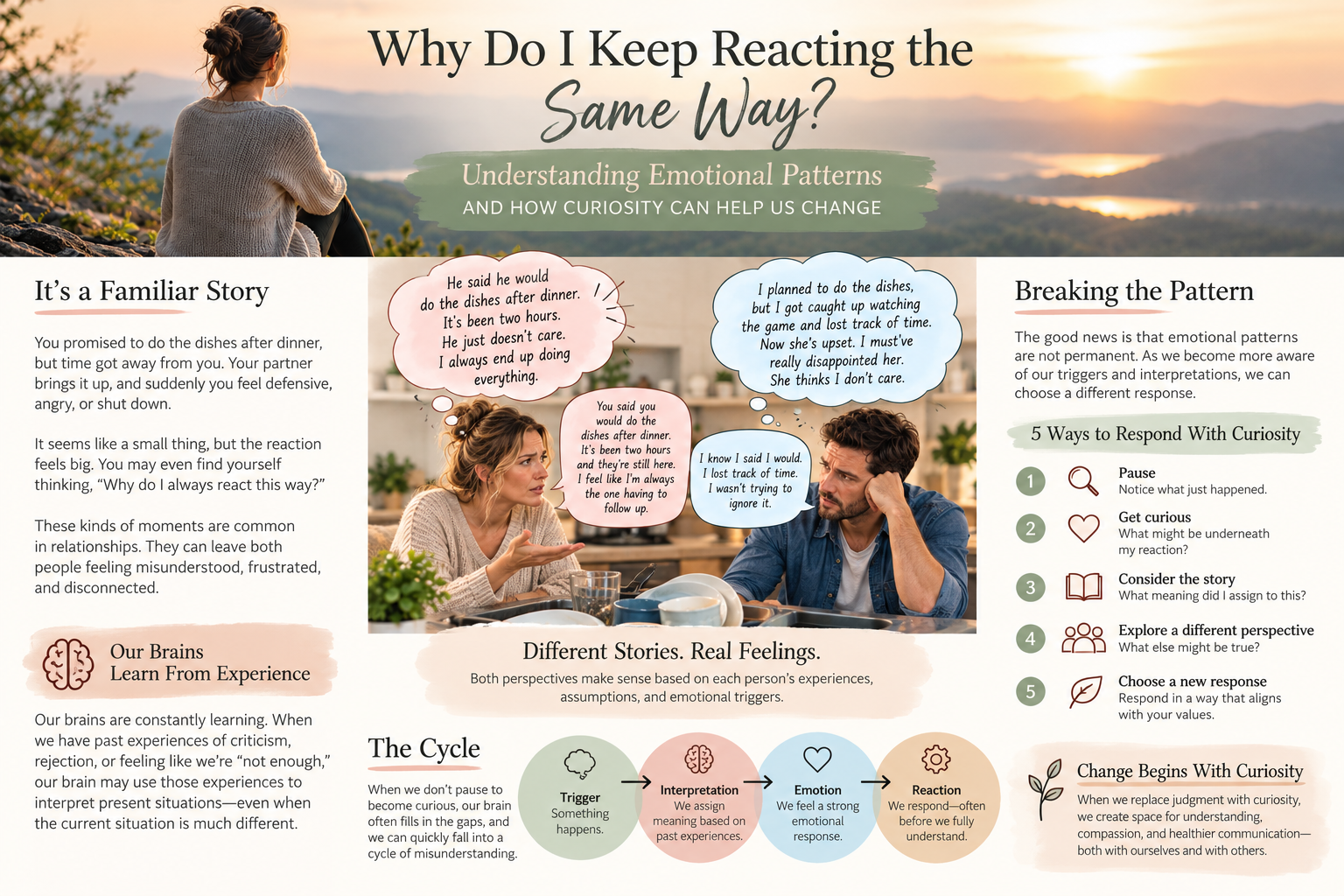

Learning to separate feelings from facts through curiosity and emotional awareness.
Have you ever been convinced that someone was upset with you, only to discover they were simply having a difficult day?
Maybe a friend didn't return your text, and you immediately assumed you had done something wrong. Or perhaps your spouse seemed distant, and your mind began telling you that something was wrong in your relationship.
Before you knew it, you were feeling anxious, rejected, hurt, or angry.
But what if the story your emotions were telling you wasn't actually true?
Your Feelings Are Real, but Your Interpretations May Not Be
Our emotions are powerful sources of information. They help us recognize what matters to us, respond to potential threats, and navigate relationships.
However, emotions can also influence how we interpret situations.
In cognitive behavioral therapy (CBT), we sometimes refer to this as emotional reasoning—the tendency to assume something must be true simply because we feel it strongly.
For example:
"I feel rejected, so they must not care about me."
"I feel anxious, so something bad must be about to happen."
"I feel guilty, so I must have done something wrong."
"I feel inadequate, so I must be failing."
Notice how quickly a feeling can become a conclusion.
The emotion itself is real and deserves acknowledgment. But the conclusion we draw from that emotion may not accurately reflect the situation.
An emotion is an experience, not necessarily evidence.
How Our Brains Create Stories
Our brains are constantly trying to make sense of the world around us.
When information is incomplete, we naturally attempt to fill in the missing pieces using our past experiences, expectations, beliefs, and emotional memories.
Sometimes those interpretations are accurate.
Other times, our brains create a story based more on what we fear than on what we actually know.
Imagine this:
You ask your spouse to take care of the dishes after dinner. Two hours later, the dishes are still sitting in the sink.
You begin feeling frustrated.
Your thoughts might quickly become:
"He never follows through."
"I always have to remind him."
"He doesn't respect my time."
Meanwhile, your spouse may have intended to do the dishes but became distracted and lost track of time.
The dishes are still there. Your frustration is understandable. And the agreement hasn't been fulfilled.
But the conclusion that your spouse doesn't respect you is an interpretation—not an established fact.
This distinction matters because we often respond not only to what happened, but to what we believe it means.
The Difference Between Facts and the Stories We Tell Ourselves
Consider the following:
The fact: Your friend hasn't returned your message.
The story: "She's upset with me."
The emotion: Anxiety or rejection.
The reaction: You withdraw, send repeated messages, or become defensive.
But what if your friend has been overwhelmed at work, dealing with family responsibilities, or simply forgot to respond?
Without curiosity, we may begin reacting to an assumption rather than the actual situation.
Curiosity Helps Us Challenge the Story
Choosing curiosity doesn't mean dismissing our feelings or convincing ourselves that everything is fine.
It means slowing down long enough to examine what we believe.
The next time you notice a strong emotional reaction, try asking yourself:
What do I know for certain? Separate observable facts from assumptions.
What story am I telling myself? Identify the meaning you've assigned to the situation.
What emotion is influencing that story? Consider whether fear, hurt, shame, or anger is shaping your interpretation.
What else might be true? Explore alternative explanations without automatically assuming the best or worst.
What response would reflect my values? Choose how to communicate or act rather than allowing the emotion to make that decision for you.
These questions create an opportunity to respond with greater awareness.
Emotional Regulation Begins With Understanding
Sometimes our emotional reactions become so intense that curiosity feels almost impossible.
When this happens, we may need to regulate our bodies before attempting to challenge our thoughts.
Simple grounding strategies—such as pressing your feet into the floor, noticing your surroundings, holding a cool object, or slowing your breathing comfortably—can help bring your attention back to the present moment.
Once the intensity begins to settle, curiosity becomes more accessible.
You might ask yourself:
"Am I responding to what is happening right now, or am I responding to what I fear it means?"
That question can make a meaningful difference.
Replace Assumptions With Understanding
Curiosity can also change the way we communicate with others.
Instead of saying:
"You obviously don't care about me."
Try:
"When the dishes weren't done after we agreed they would be, I felt frustrated and unsupported. Can we talk about what happened and agree on when they'll be finished?"
The second response doesn't ignore the problem.
It communicates the concern without assuming the other person's intentions.
This is an important part of emotional maturity: learning to acknowledge our feelings while remaining open to information we may not yet have.
Choose Curiosity Over Certainty
Our emotions can be incredibly convincing, especially when they connect to past experiences or deeply held beliefs.
But feeling certain doesn't always mean we're seeing the whole picture.
The next time you notice yourself making assumptions, try replacing:
"I know exactly what this means."
with:
"I wonder what else might be true."
Curiosity doesn't require us to ignore our instincts, tolerate unhealthy behavior, or dismiss legitimate concerns.
It simply invites us to explore the difference between what we feel, what we believe, and what we actually know.
And sometimes, that small shift is enough to change an entire conversation.
Remember: Your emotions deserve compassion. Your assumptions deserve curiosity.
Counseling Can Help You Understand Your Emotional Patterns
At GracePoint Counseling, I help individuals explore how thoughts, emotions, and past experiences influence their reactions and relationships.
Through greater self-awareness, emotional regulation, and practical coping strategies, we can work toward replacing automatic reactions with more intentional responses.
Because meaningful change often begins with one simple question:
"I wonder what else might be true?"